|
|
| Cultivation/Fermentation Technique | August 2021 |
Enhancement of β-Alanine Biosynthesis in Escherichia coli Based on Multivariate Modular Metabolic Engineering |
|
| Jian Xu,Li Zhou ,Zhemin Zhou | |
Abstractβ-alanine is widely used as an intermediate in industrial production. However, the low production of microbial cell factories limits its further application. Here, to improve the biosynthesis production of β-alanine in Escherichia coli, multivariate modular metabolic engineering was recruited to manipulate the β-alanine biosynthesis pathway through keeping the balance of metabolic flux among the whole metabolic network. The β-alanine biosynthesis pathway was separated into three modules: the $\beta$-alanine biosynthesis module, TCA module, and glycolysis module. Global regulation was performed throughout the entire $\beta$-alanine biosynthesis pathway rationally and systematically by optimizing metabolic flux, overcoming metabolic bottlenecks and weakening branch pathways. As a result, metabolic flux was channeled in the direction of $\beta$-alanine biosynthesis without huge metabolic burden, and 37.9 g/L $\beta$-alanine was generated by engineered Escherichia coli strain B0016-07 in fed-batch fermentation. This study was meaningful to the synthetic biology of $\beta$-alanine industrial production. |
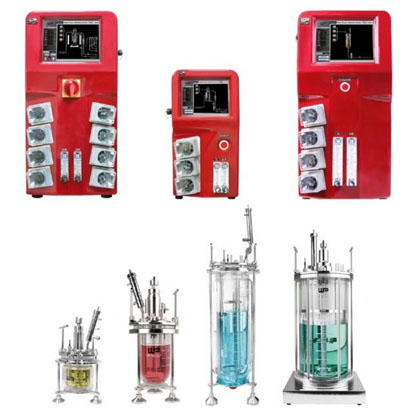 Winpact Fermentation System |
IntroductionE. coli was rationally and systematically engineered for the production ofβ-alanine. The MME strategy was applied to channel the metabolic flux in the direction of β-alanine biosynthesis with the aim of maintaining the balance of the intracellular metabolic network. The β-alanine biosynthesis pathway was separated into three modules: the β-alanine biosynthesis module, TCA module, and glycolysis module. Global regulation was performed throughout the entire β-alanine biosynthesis pathway rationally and systematically; as a result, $37.9 g/L β-alanine was generated in fed-batch fermentation.
Materials and MethodsFed-batch fermentation was carried out at 37 °C in a 5 L Winpact Major Science bioreactor (working volume 2 L). DO was maintained above 45% by adjusting airflow (2–10 L/min) and agitation (200–900 rpm). Feeding was automatically regulated based on growth rate (μ) and glycerol consumption rate (qGly).
M9Y medium per liter contained: 1 g NH₄Cl, 0.5 g NaCl, 2 g yeast extract, 3 g KH₂PO₄, 5 g glycerol, 5 mL metal solution, 6 g Na₂HPO₄, and 13.21 g (NH₄)₂SO₄. Feed medium per liter contained: 3.67 g MgSO₄, 4 g yeast extract, 4 g tryptone, 100 g (NH₄)₂SO₄, and 650 g glycerol. Results
ReferencesEvaluation of Metabolic Engineering Strategies on 2-Ketoisovalerate Production by Escherichia coli
|
|
| https://doi.org/10.3390/biology101010 | |
 |
|