|
|
| Cultivation/Fermentation Technique Methylotuvimicrobium CULTURE TECHNIQUE |
Methylotuvimicrobium Culture November 01, 2025 |
Strategies for Increasing Methane Removal in Methanotroph
|
|
| Jaden Storrer, Tansley M. Mazurkiewicz, Bodee Hancock and Ronald C. Sims | |
AbstractMethane is a potent greenhouse gas that requires its emissions to be mitigated. A significant source for methane emissions is in the form of the biogas that is produced from anaerobic digestion in wastewater reclamation and landfill facilities. Biogas has a high valorization potential in the form of its bioconversion into ectoines, an active ingredient in skin care products, by halotolerant alkaliphilic methanotrophs. Cultures of Methylotuvimicrobium alcaliphilum 20Z were grown in bench scale stirred-tank reactors to determine factors to improve methane uptake and removal. Tangential flow filtration was also implemented for a bio-milking method to recover ectoine from culture media. Methane uptake and reactor productivity increased, with a temperature of 28 ◦C compared with 21 ◦C. Decreasing the methane gas bubble diameter by decreasing the sparger pore size from 1 mm to 0.5 μm significantly improved methane removal and reactor productivity by increasing mass transfer. Premixing methane and air before sparging into the reactor saw a higher removal of methane, while sparging methane and air separately created an increase in reactor productivity. Maximum methane removal efficiency was observed to be 70.56% ± 0.54 which translated to a CH4-EC of 93.82 ± 3.36 g CH4 m−3 h−1. Maximum ectoine yields was observed to be 0.579 mg ectoine L−1 h−1. |
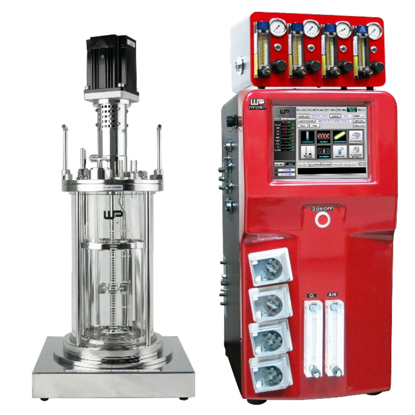 Winpact Model: FS-07-D10P |
IntroductionMethane (CH₄) is a potent greenhouse gas with a global warming potential approximately 28 times higher than carbon dioxide. Large amounts of methane are produced from landfills and wastewater treatment plants, making its efficient utilization an important environmental and economic challenge. Methanotrophic bacteria can convert methane into valuable bioproducts by using CH₄ as their sole carbon source. Among them, Methylotuvimicrobium alcaliphilum 20Z is a promising strain because of its high salt tolerance and its ability to naturally produce ectoine, a high-value compatible solute widely used in cosmetic and pharmaceutical applications due to its moisturizing, protein-stabilizing, and UV-protective properties. However, the industrial production of ectoine is limited by the low solubility and poor mass transfer of methane, which reduce methane uptake and product yield. Therefore, improving methane transfer efficiency is critical for enhancing ectoine productivity and process economics. In this study, the effects of cultivation temperature, gas sparging conditions, and gas feeding strategy on methane removal, cell growth, and ectoine production were investigated in a 10-L stirred-tank bioreactor. Tangential flow filtration (TFF) was also evaluated as a potential bio-milking method for efficient ectoine recovery.
Materials and MethodsCulture and Media
A pure culture of M. alcaliphilum 20Z was purchased from DSMZ (Leibniz Institute, Hannover, Germany). The cultures were grown on a modified mineral salt medium (MSM) formula similar to the one developed by Kalyuzhnaya et al. These modifications included increasing copper concentrations by 5 μM and adding 0.2 μM of tungsten to limit formate excretion. MSM either contained 60 g/L NaCl (6% volume) for ectoine production or 0 g/L NaCl (0% volume) for the saline-free MSM used for bio-milking. Reactor Setup Cultures were grown in a 10 L stirred-tank fermenter, using a Winpact Evo Fermentation System FS-07 series as the control unit (Major Science, Taoyuan, Tawain). The impeller was set to agitate at 300 RPM, as it has been observed that M. alcaliphilum 20Z agitated at higher speeds may negatively affect growth and ectoine production [35]. Continuous CH4 and air flow rates were 25 mL min−1 and 700 mL min−1, respectively and were controlled using rotameters. The CH4 concentrations of the influent gas were kept at approximately 4% volume of the total gas input, to be below the lower explosive limit, translating to a loading rate of 126.14 g CH4 m−3 h−1. The mass transfer of CH4 and oxygen was increased by introducing the gas mixture from the bottom to allow the impellers to break up the bubbles into smaller sizes. Cultures were grown until log phase was achieved. Conclusions Optimizing reactor operational conditions greatly improved CH4 removal by M. alcaliphilum 20Z in a stirred-tank reactor. Utilizing a gas sparger with a smaller pore size proved to be the most important factor in improving CH4 removal of the system by generating smaller bubbles that are more effective for mass transfer. Reactor configurations that used a premixed gas input of CH4 and air saw greater CH4 removal than set-ups that input gases separately. Higher temperatures allow for maximized enzyme kinetics of MMO and allow for the uptake of a greater proportion of CH4, despite lower solubility. The variation of these factors did not have a significant effect on intracellular ectoine yields but did have an effect on the reactor productivity in terms of total yield of ectoine. Increasing the specific growth rate of the culture increased the reactor productivity. Specific growth rates were increased by utilizing higher temperatures, smaller sparger pore size, and separate gas input. This study also validates the proof of concept of implementing TFF for bio-milking ectoine in methanotrophs. ReferencesJaden Storrer, Tansley M. Mazurkiewicz, Bodee Hancock and Ronald C. Sims. (2025) Strategies for Increasing Methane Removal in Methanotroph Stirred-Tank Reactors for the Production of Ectoine. Bioresources and Bioproducts, 2025, 1(2):7, 1-18
|
|
| mdpi.com/3042-8092/1/2/7 | |
 |
|