|
|
| Cultivation/Fermentation Technique | June 2023 |
Production and analysis of metabolites from solidstate fermentation of Chenopodium formosanum (Djulis) sprouts in a bioreactor |
|
| Chen-Che Hsieh , Shu-Han Yu , Hsing-Chun Kuo , Darin Khumsupan , Hsiao-Chu Huang , Yu-Wei Liou , Chen-Yu Kao , Szu-Chuan Shen , Kuan-Chen Cheng |
|
AbstractFresh fourth-day Chenopodium formosanum sprouts were fermented using Rhizopus oligosporus. Compared to plate fermentation (PF), bioreactor fermentation (BF) at 35 °C with 0.4 vvm aeration and 5 rpm yielded higher antioxidant capacity, peptide content (99.56 ± 7.77 mg/g), and enzyme activity (amylase, glucosidase, proteinase). Mass spectrometry identified two bioactive peptides (TDEYGGSIENRFMN and DNSMLTFEGAPVQGAAAITEK) as potential DPP-IV and ACE inhibitors. Over 20 novel metabolites were found in BF samples. The BF system enhances nutritional and bioactive properties, offering promise for scale-up. |
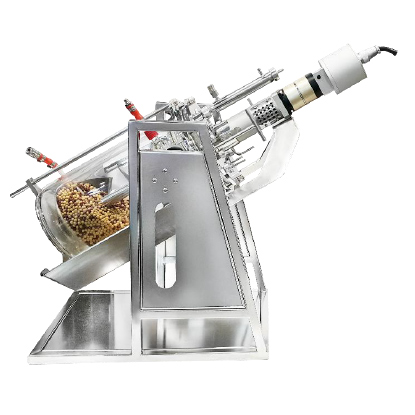 Winpact Model: FS-V-SA05P |
IntroductionChenopodium formosanum, a native pseudocereal in Taiwan, is rich in essential amino acids, phenols, flavonoids, and GABA. Although similar to quinoa, it has superior nutritional value. Solid‑state fermentation with Rhizopus oligosporus may offer a scalable way to enhance its bioactive compound profile.
Materials and MethodsFermentation Process:
Fresh fourth-day Chenopodium formosanum sprouts (1.5 kg) were sterilized and inoculated with 75 mL of Rhizopus oligosporus spores at 10^6 spores/mL (5% v/w). Solid‑state fermentation occurred in a bioreactor FSeV‑SA05P (Winpact FS‑V‑SA05P) at 35 °C, with aeration at 0.4 vvm and rotation at 5 rpm, for four days. Free peptide content was quantified as 99.56 ± 7.77 mg casein tryptone equivalent per gram dry substrate. Enzyme activities measured included amylase (2.21 ± 0.01 U/g), β‑glucosidase (54.57 ± 10.88 U/g), and proteinase (40.81 ± 6.52 U/g). Mass spectrometry was used to identify peptides and metabolites generated by fermentation; two peptides (TDEYGGSIENRFMN and DNSMLTFEGAPVQGAAAITEK) were highlighted as DPP‑IV and ACE inhibitors Results
ReferencesProduction and analysis of metabolites from solid‑state fermentation of Chenopodium formosanum (Djulis) sprouts in a bioreactor
|
|
| https://doi.org/10.1016/j.foodres.2023.112707 | |
 |
|