|
|
| Cultivation/Fermentation Technique Syntrophomonas wolfei CULTURE TECHNIQUE |
November 15, 2022 Syntrophomonas wolfei |
Simultaneous production of biohydrogen (bioH2) and poly-hydroxy-alkanoates (PHAs) by a photoheterotrophic consortium bioaugmented with Syntrophomonas wolfei |
|
| Axayacatl González, Edgar Salgado, Zaira Vanegas, Cristina Niño-Navarro, Omar Cortés, Isaac Chairez, Elvia I. García-Peña | |
AbstractDark fermentation of fruit and vegetable waste was run in a 5 L Winpact One FS-06 reactor with automatic pH and temperature control. Its effluent fed photofermentation by synthetic consortia of Clostridium pasteurianum, Rhodopseudomonas palustris and Syntrophomonas wolfei, which simultaneously produced 44.3 mmol bioH2 and 50.46% PHA. |
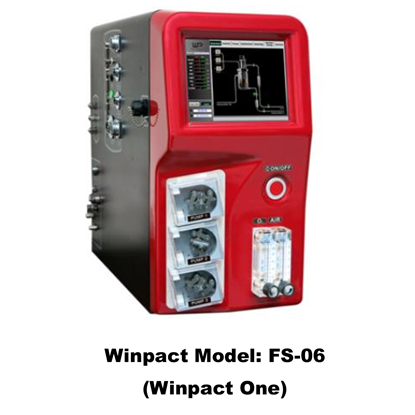 Winpact Model: FS-06 (Winpact One) |
IntroductionMotivation: biohydrogen from dark fermentation (DF) alone gives low yield because organic acids accumulate; coupling DF with photofermentation (PF) converts those acids into additional bioH2 and closes the production cycle.
Gap: bioH2 is not yet commercially viable on its own, and the microbial interactions inside photoheterotrophic consortia — particularly the competition for reducing equivalents between bioH2 and PHA — are poorly understood. Objective: co-produce bioH2 and PHA from dark-fermentation effluent, and test whether bioaugmenting a natural consortium with S. wolfei improves both. Materials and MethodsDark fermentation (bioreactor stage):
A 5 L Winpact One fermentation system (FS-06, Major Science) was filled with diluted fruit and vegetable waste and inoculated with a lactose-adapted consortium. The medium was sparged with N2 for 30 min to ensure anaerobic conditions; pH was automatically held at 6.8 ± 0.2 and temperature at 30 °C over a 96 h run, with liquid and gas sampled throughout. Photofermentation (controls): Dark-fermentation effluent was used as carbon source for individual strains (C. pasteurianum, R. palustris, S. wolfei), the natural consortium NPC-C4, the same consortium bioaugmented with S. wolfei, and a designed three-strain consortium. Analysis: Hydrogen volumetric production rate, PHA content, organic acid consumption (lactic, butyric, acetic, propionic) and COD removal. Results
ReferencesSimultaneous production of biohydrogen (bioH2) and poly-hydroxy-alkanoates (PHAs) by a photoheterotrophic consortium bioaugmented with Syntrophomonas wolfei. Fermentation 2022, 8, 644
|
|
| https://doi.org/10.3390/fermentation8110644 | |
 |
|