|
|
| Cultivation/Fermentation Technique Saccharomyces cerevisiae CULTURE TECHNIQUE |
August 15, 2022 Saccharomyces cerevisiae |
The implications of composite dark purple rice malt on phenolic acid profiles, 4-vinyl guaiacol reduction and enhancing the antioxidation of beer |
|
| Hellie Gonu, Ulaiwan Withayagiat | |
AbstractAle beer was fermented in a 5 L double-jacketed Winpact One vessel (FS-06-220) with DO, pH, foam and temperature probes. Barley malt was substituted with 40–100% Riceberry rice malt and fermented with POF+ and POF− yeasts; 40–80% rice malt retained higher p-coumaric acid, vanillic acid, anthocyanin and antioxidant activity with lower 4-vinylguaiacol. |
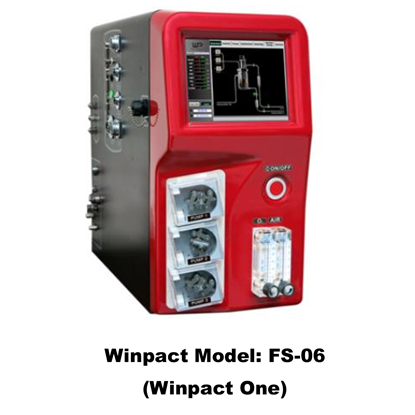 Winpact Model: FS-06-220 (Winpact One, FS-06 Series) |
IntroductionMotivation:
hydroxycinnamic acids carried over from malt are decarboxylated by yeast into 4-vinylguaiacol, a phenolic off-flavour that is undesirable in most beer styles while also marking the loss of antioxidant phenolics. Gap: the effect of rice malt — as adjunct or as base malt — on phenolic acid dynamics, antioxidation and volatile phenolic compounds had not been investigated. Objective: track phenolic acids, antioxidant activity and 4-vinylguaiacol through mashing, fermentation and maturation for composite Riceberry rice / barley worts fermented with a phenolic-off-flavour-positive and a negative yeast. Materials and MethodsBioreactor configuration:
A complete Winpact One fermenter system with a 5 L double-jacketed vessel (FS-06-220, Winpact Scientific, Saratoga, CA, USA) held 4.2 L of oxygen-saturated wort. The vessel was monitored through a control unit with dissolved oxygen probe, pH probe, foam detection probe and temperature probe, with a coolant system connected to the heat exchanger (Winpact One FS-06 Series). Fermentation conditions: Impeller set at 100 rpm for gentle mixing and shorter time to attenuation; 72 h at 20 °C; impeller then stopped for yeast flocculation over 6 days at 4 °C. 50 mL samples were taken every 12 h. Treatments and controls: Riceberry rice malt substituted barley malt at 40, 60, 80 and 100% (w/w), with 100% barley malt as control; each wort fermented separately with POF+ (S. cerevisiae var. diastaticus) and POF− (S. cerevisiae) yeast. Analysis: Sugar and ethanol, phenolic acids and 4-vinylguaiacol by HPLC, beer colour by spectrophotometry, and antioxidant activity. Results
ReferencesThe implications of composite dark purple rice malt on phenolic acid profiles, 4-vinyl guaiacol reduction and enhancing the antioxidation of beer. Fermentation 2022, 8, 392
|
|
| https://doi.org/10.3390/fermentation8080392 | |
 |
|