|
|
| Cultivation/Fermentation Technique Thermophilic AD consortium CULTURE TECHNIQUE |
July 7, 2021 Thermophilic AD consortium |
Higher bacterial diversity in two-phase thermophilic anaerobic digestion of food waste after micronutrient supplementation |
|
| Ajay Menon, James Lyng, Apostolos Giannis | |
AbstractA continuous two-phase thermophilic AD system (10 L acidogenic + 20 L methanogenic; Winpact, USA) ran for 210 days on food waste at 55 °C. Supplementing Ca, Mg, Co and Ni raised methane yield by up to 40% and increased bacterial Shannon diversity from 1.112 to 2.046. |
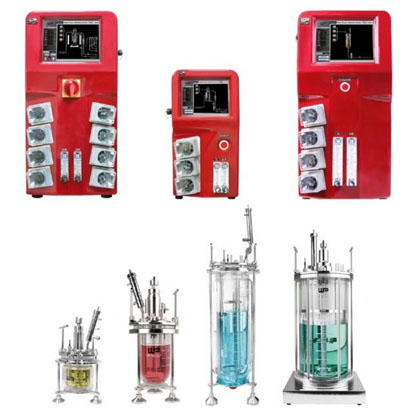 Winpact Fermentation System |
IntroductionMotivation:
thermophilic AD is more productive than mesophilic AD but far less stable, and trace-metal deficiency drives instability and inoculum washout in the methanogenic phase. Gap: the authors had already shown that a Ca/Mg/Co/Ni cocktail recovers a destabilised digester and lifts methane yield 40%, but the underlying change in the bacterial community had not been identified. Objective: use next-generation sequencing to determine which bacterial groups drive the recovery, stabilisation and improvement of the process after supplementation. Materials and MethodsReactor setup:
Continuous two-phase thermophilic AD, comprising a 10 L reactor for hydrolysis and acidogenesis and a 20 L reactor for methanogenesis (Winpact, USA), monitored for pH, ORP and biogas production. The methanogenic vessel was held at temperature by a thermal jacket. Operating conditions: Both reactors at 55 °C; HRT 5 days (acidogenic, 2 L/day) and 15 days (methanogenic, 1.3 L/day), 20 days total; feedstock food waste at OLR 3 gVS/L/day and pH 4.5 ± 0.3; acidogenic effluent fed the methanogenic phase; total run 210 days. Supplementation (control period): The first 149 days ran without micronutrients, giving overacidification and washout. On day 150 a cocktail of 303, 777, 7 and 3 mg/L of Ca, Mg, Co and Ni was dosed, then repeated twice at 20-day intervals. Analysis: Sludge sampled at days 149, 170 and 210; genomic DNA sequenced on the Illumina MiSeq platform and analysed with QIIME, visualised with Krona. Results
ReferencesHigher bacterial diversity in two-phase thermophilic anaerobic digestion of food waste after micronutrient supplementation. Biomass Conversion and Biorefinery (2021)
|
|
| https://doi.org/10.1007/s13399-021-01704-6 | |
 |
|