|
|
| Cultivation/Fermentation Technique | August 2022 |
Evaluation of Metabolic Engineering Strategies on 2-Ketoisovalerate Production by Escherichia coli |
|
| Li Zhou , Ying Zhu, Zhongzhe Yuan, Guangqing Liu, Zijin Sun, Shiyu Du, He Liu, Yating Li, Haili Liu, Zhemin Zhou | |
Abstract2-Ketoisovalerate, a key metabolic intermediate for pharmaceuticals and biofuels, suffers from low fermentation yields due to redox imbalance. By systematically engineering E. coli—deleting competing pathways, overexpressing key enzymes, tuning NADPH supply, and enhancing aerobic respiration—researchers achieved 46.4 g/L and 0.644 mol/mol glucose yield. Further modifications to acetolactate synthase and degradation tagging of PDH reduced by-product formation and NADH accumulation. Under a two-phase (aerobic–microaerobic) strategy, PDH degradation improved redox balance, reaching 55.8 g/L, 2.14 g/L·h, and 0.852 mol/mol glucose. These findings outline an effective metabolic engineering approach for high-yield production of redox-imbalanced fermentative metabolites. |
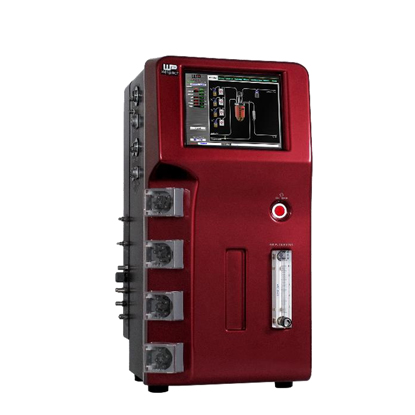 Winpact FS-02 Fermentation System |
Introduction2-Ketoisovalerate is a valuable intermediate for pharmaceuticals and biofuels, serving as a precursor for branched-chain amino acids and isobutanol. Chemical synthesis is unsustainable, making microbial fermentation from glucose a preferred route. To enhance yield, E. coli metabolism must be engineered—removing competing pathways, optimizing enzyme specificity (especially AlsS), and managing redox balance. Since 2-ketoisovalerate formation generates excess NADH and requires NADPH, strategies such as NADH-to-NADPH conversion and controlled aeration are essential. Because PDH activity exacerbates NADH accumulation and diverts pyruvate flux, a timed PDH shutdown after biomass buildup offers a balanced solution for efficient 2-ketoisovalerate production.
Materials and MethodsFor each bioreactor experiment, cells were precultured in LB medium, as described in the shake-flask experiments. The 100-mL LB broth was used as a seed culture to inoculate 2-L medium with 30 g/L glucose, which was contained in a 5-L bioreactor (Winpact FS-02; Major Science, Saratoga, CA, USA). A two-phase fermentation with a cell growth phase was maintained at 37°C, and then a 2-ketoisovalerate production phase maintained at 30°C was initiated. Dissolved O2 concentration was controlled at the indicated saturation by stirring at 200 to 1,000 rpm and sparging air into the bioreactor at 3 to 10 L/min. To adjust the pH to 7, concentrated NH4OH was added automatically. At the initiation of the second phase, 0.38 g IPTG was added to the broth. Six batches of 5 g yeast extract and 5 g peptone were fed into the bioreactor as an organic nitrogen source to obtain a higher cell density. Glucose was fed into the bioreactor to maintain the residual glucose concentration above 10 g/L.
Results
ReferencesEvaluation of Metabolic Engineering Strategies on 2-Ketoisovalerate Production by Escherichia coli
|
|
| https://doi.org/10.1128/aem.00976-22 | |
 |
|